How to Grow a BS-Ometer (Before Charisma Costs You a Hire)
August 11, 2026

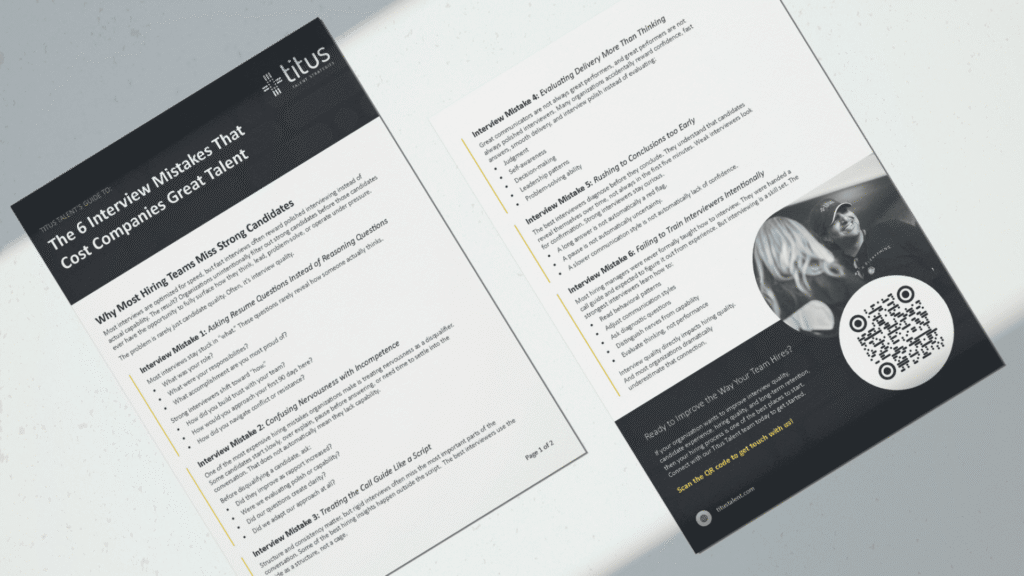
AI has made it easier than ever for candidates to prepare for the questions they’ll face in an interview. But when charisma, confidence, and communication are part of the job, a polished interview can make the wrong candidate look like the right one. Here’s why hiring teams need to sharpen their BS-ometer and start asking better questions.
Reading Time: 11-12 Minutes

Marcus could sell you his own resignation letter.
Fifteen minutes into a screen for a sales role, he’d made the hiring manager laugh twice, name-dropped a mutual connection, and walked through a deal that sounded like it belonged in a Harvard case study.
Everyone on the call was already picturing him at the next sales kickoff, but nobody had asked him a single question he couldn’t have answered in his sleep.
That’s just how interviewing works now. A February 2026 Jobright analysis found ChatGPT can correctly predict seventy to eighty percent of the questions in a typical interview once it’s fed the job description. Feed it a few real transcripts, and it will draft the answer too, complete with a clean, quotable number at the end.
Charisma used to be the wildcard in an interview. Now it comes with a script.
That pairing gets especially dangerous in roles where charm is part of the actual job. Sales, business development, account management: the exact trait you’re hiring for is the trait most likely to talk you out of asking a second question. A weak engineer usually gives themselves away on the first technical question. A weak salesperson can carry a room for a full hour on personality alone, because carrying a room is the one skill they’ve rehearsed the most under pressure.
Time to grow your BS-ometer.
Charm Isn’t a Red Flag. It Just Isn’t Evidence.

Every hiring manager has a gut. The trouble is the gut can’t tell the difference between “this person will crush quota” and “this person is fun to talk to for thirty minutes.”
That confusion has a name: the halo effect. One strong, visible trait, usually confidence or warmth, bleeds into every trait you can’t see yet, like judgment, follow-through, or how someone behaves when a deal falls apart mid-quarter. Psychologist Edward Thorndike first documented it back in 1920, watching military officers rate soldiers who scored well on one quality as impressive across the board, whether or not the evidence for the rest was actually there.
It’s measurable, too. Frank Schmidt and John Hunter’s landmark review of eighty-five years of hiring research found that structured interviews carry a predictive validity of .51 against future job performance, versus .38 for unstructured ones. Structure, built around a consistent set of questions and a scoring rubric, beats the loose, conversational format a charismatic candidate is best at steering.
A charismatic answer and a true answer sound identical right up until you ask a second question.
Charisma still counts for something real. For a role where the entire job is building trust with strangers fast, it’s a legitimate, job-relevant signal. The problem is letting it stand in for the substance you haven’t actually checked yet. That second question is your BS-ometer. Structure grows it. Vibes starve it.
Every Candidate Has a Script Now. Ask What Isn’t On It.
Reasonable people disagree about whether that’s fair game or an unfair edge. Either way, it changes what a smooth answer is actually worth as a signal.
The Greenhouse 2026 Candidate AI Interview Report, based on nearly three thousand job seekers across five countries, found that 63 percent had been interviewed by an AI in the past year, up from 50 percent only two quarters earlier. A May 2026 Resume Genius survey of a thousand active job seekers found 22 percent now use AI tools live, mid-call, while you’re still asking the question.
That volume of AI-assisted prep is simply normal now. A smooth answer no longer settles whether the person in front of you can actually do the job.
Better questions are the fix. Researchers who study deception for a living have found that people telling the truth answer instantly, while people working from a rehearsed script slow down and make more errors the moment a question falls outside what they prepared for. One of the most reliable ways to trigger that gap is also one of the simplest: ask someone to tell their story out of order. A true memory can be told backward, sideways, or starting from the middle without much cost. A rehearsed one was built to run in one direction only.
So don’t ask what’s on the script. Ask what’s sitting right next to it:
- “What was the number, exactly?”
- “Who on the other side pushed back, and what did they say?”
- “Walk me through it backward, starting from the signature.”
- “What did you try first that didn’t work?”
A rehearsed story survives the first telling. It rarely survives being told sideways.
The Specificity Test

A March 2026 survey of 1,500 recent job seekers by background-screening firm GCheck found that 93 percent admit to embellishing or lying somewhere in the hiring process. Forty-seven percent said they’d made up an entire story on the spot to answer an interview question.
That number is a case for structure. A hunch won’t catch what a checklist will.
Listen for the pronoun. “We hit 140 percent of quota” tells you about a team. “I closed the accounts that got us there” tells you about a person. BS tends to live inside “we.”
Listen for friction. Real stories have a moment where something didn’t work, a person disagreed, a plan changed halfway through. A story with zero resistance in it plays like a highlight reel on repeat.
Listen for the shape. If every answer follows the identical three-act structure with a suspiciously tidy ending, you’re listening to a rehearsed slide, dressed up as a memory.
The best liars don’t sound nervous. They sound rehearsed.
This matters more, not less, for a candidate who’s genuinely good at selling. A real top performer remembers the client’s name, the exact objection, the number on the contract, because remembering those details is half the job. If the story stays fuzzy right where the job would have made it sharp, that’s the tell.
Run this test enough times and a pattern shows up: candidates who actually did the work get more specific under pressure, not less. The ones performing the work get vaguer.
Should You Be Talking for 30 Minutes? No.
Here’s the question every hiring manager eventually asks: on an hour-long call, how much of that hour should be you?
The honest answer is closer to twelve minutes than thirty. The widely used 80/20 rule for interviewing puts the interviewer’s share at roughly 20 percent of total talk time, leaving the other 80 percent, close to fifty of your sixty minutes, for the candidate.
That math gets harder with a charismatic candidate, because charm is often just a talent for redirecting airtime. A great salesperson can turn a screen into a conversation about you, your team, your favorite client story, without you ever noticing the ratio has flipped.
Check the clock at the thirty-minute mark. If you’ve done most of the talking, you were the one being sold.
A couple of minutes up front on the role and the team earns its keep, and so does answering real questions at the end. The line to watch is between talk time that sets up a sharper answer and talk time that simply feels good in the room.Save the first kind for framing the question and chasing the follow-up. Everything else belongs to them.
How to End It Early (and Why That’s the Kind Version)

Ten minutes in, sometimes you already know. A must-have is missing. The specificity test keeps failing. The story that felt great at minute two feels thinner at minute twelve.
Most interviewers keep going anyway, out of politeness, out of momentum, out of not wanting to be the one who says it out loud first.
Ending early well takes three moves:
- Thank them, specifically. Name the one thing they said that was genuinely good.
- Be honest about the gap, briefly. “This role needs more hands-on X than what I’m hearing today” lands kinder than a former rejection two weeks later.
- Leave the door somewhere. Passive candidates remember exactly how they were treated when it didn’t work out. In a headhunting relationship built on referrals, that memory is most of the business.
You’re not doing someone a favor by performing an hour you don’t need. You’re doing them a favor by telling the truth in twelve minutes instead of sixty.
The Wrap Up
A BS-ometer runs on three things: structure, a second question, and permission to stop the moment you have your answer.
Charisma is a real, valuable, often job-relevant skill. Whether someone can do the rest of the job is a separate question entirely, and the only way to answer it is to keep asking after the good answer arrives.
Ready to Build an Interview Process Charm Can’t Talk Its Way Through?
At Titus Talent Strategies, every search we run is built on structured, job-specific scoring that holds up after the good conversation ends. We build the rubric before the first call, so the second question gets asked every time, for every candidate, charismatic or not.
If you want a hiring process with a working BS-ometer built in, let’s talk.
Frequently Asked Questions
What is a “BS-ometer” in hiring?
A BS-ometer is the habit of asking a second and third question before trusting a candidate’s first answer, applied consistently to every candidate. It’s built from specific follow-ups, requests to retell a story out of order, and a checklist for vague language. Growing one takes practice, and a willingness to keep asking after a good answer.
How much of my time does this partnership actually require?
Less than most clients expect, and it’s front-loaded rather than spread evenly. A focused kickoff call, a short calibration touchpoint or two, and fast responses to submittals and interview requests cover most of it. The searches that drag on are almost always the ones where that early time never got spent.
How much should I be talking versus the candidate?
Aim for roughly 20 percent of the call, which works out to about twelve minutes on a sixty-minute interview. The remaining time should go to the candidate answering and to you following up on specifics. We break this down further in How to Spot an A-Player in 30 Minutes.
Is it rude to end an interview early?
No, as long as it’s handled with a specific thank-you, honesty about the gap, and a respectful close. Most candidates prefer a clear, early answer over sitting through forty more minutes of questions that no longer matter. The genuinely rude version is dragging out a conversation everyone already knows the outcome of.
Are charismatic candidates more likely to be lying?
Not necessarily. Charisma and honesty are separate traits that happen to get confused in an interview room, and a charismatic candidate can be entirely truthful while a quiet one invents every word. The specificity test works the same way regardless of how someone comes across.
What’s a good follow-up question to catch a rehearsed answer?
Ask for a specific number, name, or detail that wasn’t part of the original story, or ask the candidate to retell it starting from the end. Genuine memories tend to hold up when told out of order, while rehearsed ones tend to fall apart. The goal is simply to see whether the detail was ever really there.
Does this apply outside of sales roles?
Yes, though it matters most in roles where communication skill is itself part of the job, like sales, business development, or client-facing positions. Any role can produce a well-rehearsed, AI-assisted answer, so the specificity test and the second-question habit generalize well beyond sales. The stakes are simply higher when charm is one of the actual qualifications.
Can structured interviews fully eliminate bias like the halo effect? roles?
No single method eliminates bias completely, but a standardized rubric and consistent questions significantly reduce how much a single trait like charisma can skew a score. Using multiple trained interviewers who record their notes independently before discussing them as a group helps further. We go deeper on removing bias from candidate evaluation in Is Your Selection Process Biased? 5 Ways to Ensure You’re Hiring the Best Candidates.
Let's Start a Conversation
TITUS INSIGHTS
Refreshing perspectives and practical expertise from the Titus team.