Build the Workplace Culture you Actually Want
April 23, 2026
Most companies say culture matters. Few build it on purpose. Workplace culture isn’t created through perks or posters. It’s shaped by clarity, reinforced through consistency, and ultimately defined by the people you bring in.
In this blog, we break down what different workplace models reveal about culture.
Reading Time: 6-8 Minutes

Nearly every business leader says they care about culture. Very few have a deliberate system for building it. The ones who do, whether their team sits in a single office, spans five time zones, or something in between, tend to share one thing in common: they treat culture as intentional, not accidental.
Culture doesn’t drift toward excellence. It erodes toward mediocrity unless you actively nurture it. And that nurturing starts long before someone joins the team, even before the hiring begins.
Below, we look at three workplace models and what each one teaches us about building something worth belonging to, then we get to the part that most culture conversations quietly skip over.
REMOTE – Titus Talent EOS-powered cadence, values-led connection across remote teams | HYBRID – Zappos In-person culture roots meeting flexible remote infrastructure | ON-SITE – Flight Story Physical environment as a deliberate cultural asset |
The Remote Model: Structure as a Substitute for Proximity

Titus Talent, a recruitment and talent advisory firm, operates as a fully remote business, and we’ve built one of the more intentional cultures in our sector. Our secret isn’t a particular perk or a particularly warm Slack channel; it’s structure.
Titus runs on the Entrepreneurial Operating System (EOS), a framework that gives every layer of the business a deliberate rhythm. That rhythm does something critically important for remote teams: it replaces the ambient awareness that comes from sharing physical space. When you’re not bumping into colleagues in a corridor, you need engineered mechanisms to know what’s happening, who’s working on what, and whether the business is healthy.
In practice, this means three recurring touchpoints every week. The weekly one-on-one gives every employee a direct line to their manager; a space to surface blockers, discuss development, and feel genuinely seen rather than just functionally useful. The Level 10 meeting (L10) brings the wider regional team together around a structured agenda: headlines, scorecard review, quarterly priorities, and issues to resolve. Nothing is left to drift. The weekly huddle keeps the whole company aligned on immediate priorities without spiraling into an unproductive all-hands.
“When you’re not bumping into colleagues in a corridor, you need engineered mechanisms to know what’s happening, who’s working on what, and whether the business is healthy.”
But operational rhythm only solves half the problem. Remote culture also needs a values infrastructure; a genuine operating philosophy that travels across screens and time zones, informing decisions at every level. At Titus, core values aren’t decorative. They’re the filter through which hiring decisions are made, performance is evaluated, and conflict is resolved. When every employee knows the values and can see leadership living them out, culture becomes portable.
The third pillar is longer-horizon clarity. Titus uses an annual progress cadence built around three categories: People, Partners, and Profits. This structure ensures the business reviews not just financial performance, but the health of its relationships, both internal and external. It prevents the tunnel vision where leaders fixate on revenue while culture quietly erodes underneath them. It’s a people-first approach that mirrors the hydrologic cycle: Pour into your people, who in turn pour into your Partners, who generate the profits that are poured back into people.
| 01 PEOPLE | 02 PARTNERS | 03 PROFITS |
Most businesses get the Profits review right. Fewer get the Partners review right. Fewer still build a genuine People review into their rhythm; one that asks hard questions about retention, engagement, development, and whether the team they have is the team they need for the next chapter of the business. Flexibility and agency are two characteristics that underpin Titus’s culture. Finding the right people who will take ownership of their roles and those they work with and for is critical to the organization’s success and culture.
The Hybrid Model: Culture as a Muscle, Not a Memory
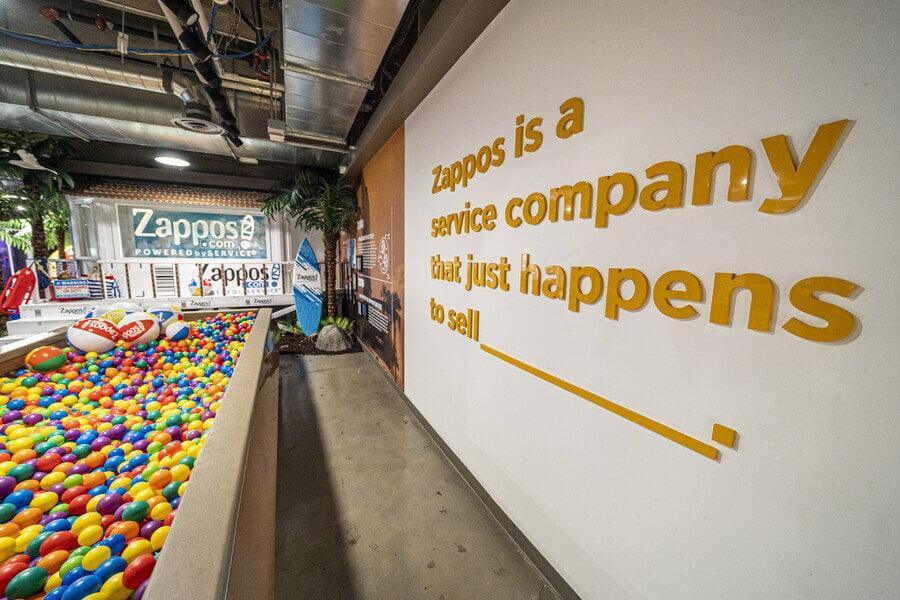
Zappos built one of the most celebrated workplace cultures in American business history. Their Las Vegas campus was famous for its elaborate interiors, spontaneous rituals, and an almost absurdist commitment to happiness as an operational value. And then, like most companies, they had to figure out what that culture meant when people stopped showing up every day.
The shift to hybrid forced Zappos, and organizations like it, to confront an uncomfortable truth: a lot of what felt like culture was actually just proximity. The rituals, the energy, the sense of belonging; much of it was tied to a physical place. When the place disappeared, the culture had to be actively rebuilt rather than passively maintained.
What Zappos discovered in their gradual return to the office was that hybrid works best when it’s intentional rather than default. It’s not “come in when you feel like it.” It’s “come in for these specific moments: onboarding, team rituals, collaborative problem-solving, because those moments need the room.” Remote days are protected for focused work. On-site days are protected for human connection. Research from Owl Labs’ State of Hybrid Work consistently shows that employees value flexibility, but what they value even more is clarity about what’s expected of them.
“Hybrid works best when it’s intentional rather than default. Come in for these specific moments — because those moments need the room.”
The caution from some Zappos employees that the company has moved toward more rigid practices than its famously freewheeling past is worth sitting with. It points to one of the central risks in hybrid: in trying to create fairness and consistency across remote and in-person workers, businesses can accidentally drain the flexibility that made hybrid appealing in the first place. Hybrid culture requires constant maintenance. It’s a muscle, not a memory. You don’t get to build it once and coast.
Design your hybrid around purpose, not convenience. Be deliberate about which activities belong in-person and which don’t. And audit regularly, not just whether the model is working operationally, but whether your people still feel the energy that made them want to work there.
The On-Site Model: Space as a Cultural Statement

Steven Bartlett, founder of Flight Story and one of the UK’s most prominent entrepreneurs, has been one of the more outspoken advocates for on-site culture in recent years. His position isn’t reactionary nostalgia for the pre-pandemic office. It’s a considered belief that physical environments shape cognitive and emotional states, and that for creative, fast-moving businesses, shaping matters enormously.
At Flight Story, the office isn’t incidental. It’s a deliberate cultural artefact. The environment is designed to signal what the company values: excellence, ambition, and the belief that the work is worth showing up for. Bartlett has spoken publicly about the compound effect of being around talented, motivated people in real time; the informal learning, the energy transfer, the social pressure that raises everyone’s game in ways that no Zoom call can quite replicate. At Flight Story and his team, people are in the office around 80% of the time — not because of a mandate, but because that’s what the culture has defined as the expectation.
“The office isn’t incidental to Bartlett’s culture strategy — it’s a deliberate artefact. The environment is designed to signal what the company values before anyone says a word.”
This isn’t an argument that remote workers are less committed or less productive. It’s an argument that certain kinds of culture, particularly those that depend on osmosis, mentorship, and the accelerated trust that comes from shared physical experience, are genuinely harder to replicate at a distance. For early-stage businesses, highly creative teams, and organizations still forming their identity, on-site can be a strategic advantage rather than a constraint.
The risk is rigidity. On-site mandates without compelling reasons become resentment generators. The answer isn’t to abandon the model, it’s to make the case for it so compellingly that people want to be there. If your on-site culture is strong enough, attendance stops being a policy and starts being a preference.
You Don’t Have a Culture Problem. You Have a People Problem.

Most culture problems aren’t culture problems at all. They’re the accumulated consequence of hiring decisions made under pressure, with optimism substituting for insight; speed overtook need. One wrong hire at the wrong level, someone who is talented but doesn’t share values, who is effective but subtly corrosive, can do more damage to a team’s culture than a year of misaligned strategy.
Skills are learnable. Character is largely fixed by the time someone walks through your door.
You can train someone to use your systems, understand your processes, and develop new technical abilities. You cannot train someone to care about the things you care about. You cannot train integrity, generosity, accountability, or the instinct to make a colleague’s day easier rather than harder. Either it’s there, or it isn’t, and no amount of onboarding will install it if it isn’t.
This means that the most powerful culture intervention available to any hiring manager isn’t a team away-day or a values workshop. It’s the next hiring decision. Every person you bring into the business either reinforces the culture or dilutes it. There is no neutral. Someone who is a brilliant performer, but a poor values fit, doesn’t cancel out; they corrode. The numbers back this up: research from SHRM surveying more than 2,100 CFOs found that 95% said a poor hiring decision at least somewhat impacts team morale, and the financial cost of a single bad hire can reach upward of $240,000 at the executive level when you factor in recruitment, lost productivity, and the cultural damage left behind.
The flip side is equally true. One great hire who genuinely lives the values, who raises standards by example, who treats people well under pressure, who cares about the work and the team in equal measure, can do more for your culture than any initiative you’ll ever run. Great people attract great people. They create an environment where the right behaviors get reinforced, where the bar rises naturally, and where the wrong people quietly self-select out. Gallup research shows that highly engaged workers demonstrate 18% higher productivity in sales, and engagement is downstream of values alignment.
Hiring for culture fit is not about hiring people who are the same. It’s about hiring people who share the same fundamental values while bringing different perspectives, backgrounds, and skills to the table. McKinsey research consistently shows that diverse teams outperform homogeneous ones — but that diversity of thought and experience is only a strength when it’s anchored to a shared set of values. Diversity of values tears a culture apart.
So, before you launch another culture initiative, ask yourself an honest question: Do you actually have a culture problem, or do you have two or three people in the building who shouldn’t be there? The answer will tell you where to spend your energy. And if you need a rigorous framework to make better hiring decisions, the 84% of recruiters who now consider cultural fit a key hiring criterion are ahead of the game — but having the framework matters more than having the statistic.
What it All Comes Down To
Strip away the particulars; the EOS cadences, the Vegas campus, the Flight Story aesthetic, and you find the same underlying architecture in every high-performing culture, regardless of model.
| Clarity of values Not aspirational words on a wall, but a genuine operating philosophy that shapes decisions at every level | Structured communication Consistent rhythms that make invisibility impossible and keep everyone aligned, regardless of where they sit | Deliberate hiring Every hire either reinforces the culture or dilutes it. Treat the hiring decision as the most powerful culture lever you have |
Whatever model you choose, remote, hybrid, on-site, or some version of all three, the most important move is the same. Decide, deliberately, what kind of culture you want. Build the systems and rhythms that make it visible. And then hire people who already believe what you believe.
Culture doesn’t drift toward excellence. You have to engineer it, and the engineering starts the moment you write the job description.
READY TO BUILD A CULTURE WORTH BELONGING TO?
Titus Talent is more than a recruitment agency. As a fully fledged talent strategy firm, we partner with leaders to build the people infrastructure that makes great culture possible — from hiring strategy to leadership alignment. Our Talent Strategy Memberships give you ongoing access to the frameworks, expertise, and community that most companies only discover too late.
Step 5: Connection That Inspires
Culture Creators Community — Join exclusive speaker sessions and peer cohorts for candid conversations, practical insights, and transformative leadership growth.
Let's Start a Conversation
TITUS INSIGHTS
Refreshing perspectives and practical expertise from the Titus team.