Job Hoppers Can’t Be Trusted (and Other Hiring Myths Costing You Top Talent)
May 6, 2026

“Job hopper.” “Red flag.” “Too risky.”
These labels feel like wisdom, but they’re often just fear in disguise. In today’s talent market, relying on outdated hiring instincts can quietly cost you your best candidates. What if the resume isn’t the verdict… but the starting point for better questions?
Reading Time: 8-10 Minutes

Job hoppers can’t be trusted. Short stints mean someone is unreliable. A gap in the resume likely means something terrible happened; something that makes this candidate a very real threat to the well-being of your organization.
You wouldn’t be the first hiring leader to think that. And you wouldn’t be the first to let confirmation bias dress itself up as discernment and derail your hiring process before you’ve got a little curious (or had your TA team do some digging).
Here’s the problem: those instincts feel like pattern recognition. They feel like experience talking. But more often than not, they’re fear talking; fear of a bad hire, fear of being blamed, fear of the unknown. And in a market where nearly 7 in 10 organizations still report difficulty filling roles, fear is an expensive filter.
A resume or LinkedIn profile records movement, not motivation. It shows you where someone was, never why they left, what they learned, or what they were building toward when they went. The hiring leaders who understand that treat the resume as a prompt. A list of questions worth asking. Not a verdict handed down before the conversation starts.
Early Career Movement Is Iteration, Not Instability

Early career candidates (anyone in their first five years) need a completely different evaluative lens. What looks like instability on paper is usually just what building a career actually looks like up close.
Bureau of Labor Statistics data puts the average tenure for Gen Z employees at approximately two years. That’s not a defect. That’s the workforce telling you something about what it needs. LinkedIn’s Future of Recruiting report found Gen Z is 45% more likely than Gen X to prioritize skill-building when evaluating a role. When you don’t offer it, they find someone who does. That’s not disloyalty. That’s cause and effect.
85% of Gen Z candidates say they weigh long-term growth goals when considering a new role. They’re not hopping. They’re hunting for development, for challenge, for somewhere that takes their trajectory seriously. The hiring manager who reads that as a red flag isn’t protecting their culture. They’re just making their shortlist shorter.
The question worth asking is never why did they leave? It’s: what did they learn, and are they moving toward something or perpetually away from everything? Those are different people. A good conversation will tell you which one you’re dealing with. A resume scan never will.
How to Ask About Short Stints Without Calling Your Lawyer After
Here’s where good instincts go wrong. The desire to understand a candidate’s history is completely legitimate. It’s the execution that creates the exposure.
EEOC guidelines require that interview questions be tied to job-related qualifications — not personal characteristics. Career gaps are frequently connected to pregnancy, disability, mental health treatment, family medical leave, or military service. Federal law prohibits basing employment decisions on any of these characteristics, and questions that surface them, even indirectly, don’t need to be intentional to be problematic. Intent is not a defense.
The good news: you don’t need to go anywhere near that territory to get what you actually want to know.
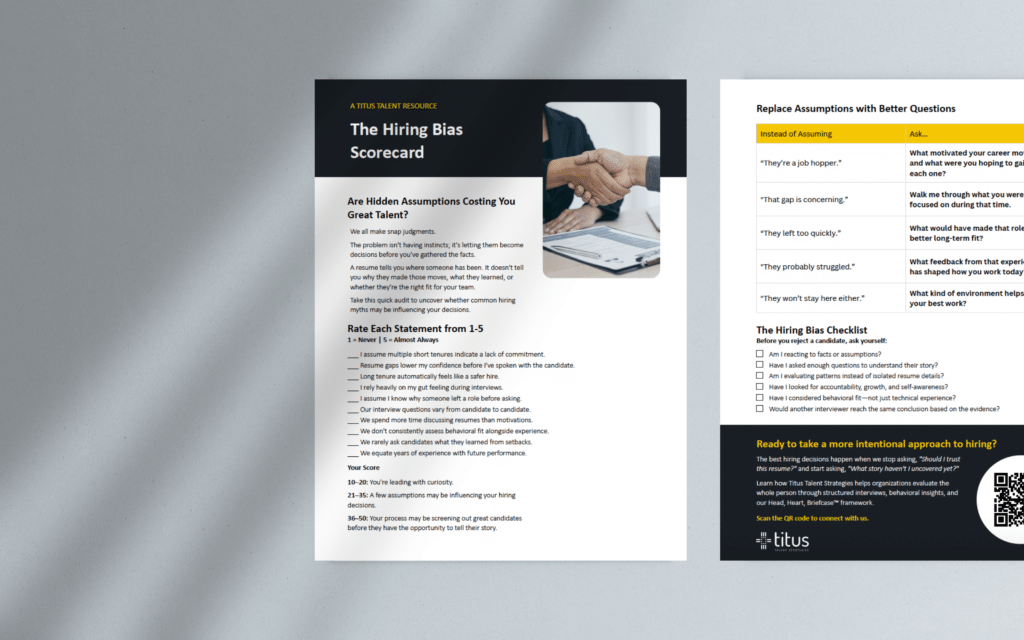
Instead of: “Why the gap?”
Try: “Walk me through what you were focused on during that period and what you were looking for when you re-entered the market.”
Instead of: “Why did you leave so quickly?”
Try: “What would have made that role a longer-term fit for you?”
Instead of: “Were there performance issues?”
Try: “What feedback did you receive in that role that shaped how you approach your work today?”
Training hiring managers on structured, legally sound interview frameworks isn’t optional — it’s your primary defense against inconsistent, legally exposed hiring practices. But here’s the thing: these aren’t just safer questions. They’re genuinely better ones. They don’t just keep you out of trouble. They surface the self-awareness, accountability, and growth orientation that actually predict whether someone will perform and stay.
The Performance Conversation Nobody Wants to Have

Sometimes short stints are performance-related. That’s not a reason to stop reading. It’s a reason to read more carefully.
What you’re evaluating isn’t the record. It’s the capacity for honest self-reflection. A candidate who can say clearly: “I struggled, here’s what I learned, here’s how I’d approach it differently”; that’s someone worth your attention. A candidate who traces every departure back to a bad manager, a toxic culture, and an unreasonable team, every single time, with zero personal ownership; that pattern tells you something, too, and it’s not subtle.
This is where our Head, Heart, and Briefcase framework does its best work. Behavioral drive and cognitive approach (Head), motivational alignment and values fit (Heart), and technical competency and track record (Briefcase). A candidate’s explanation of a difficult departure tells you more about their Head and Heart than almost any other question you’ll ask. Listen for the proportion of ownership to blame. That ratio is the signal.
One more thing on references: stop asking “would you rehire this person?” Everyone has been coached to dodge it. Ask instead: “What conditions does this person need to do their best work?” That answer is harder to sidestep and far more useful.
The True Predictors of Longevity
Here’s what predicts whether someone stays: not where they’ve been, but what they’re walking into.
Gallup research shows that 75% of the reasons people leave come down to their manager, not the company, not the compensation. The manager. And managers account for 70% of the variance in team-level engagement. Seventy percent. The person conducting your interview is, in all likelihood, the single greatest retention variable your organization controls, and most of them have never been trained to lead, let alone to interview.
The internal mobility data sharpens this. Employees who make an internal move are 40% more likely to stay at least three years. Deloitte research shows companies with formal mobility programs retain employees an average of 7.4 years — versus 4.1 years for those without. Organizations hunting for “commitment signals” in external candidates while offering no internal path forward are trying to solve a retention problem with a hiring solution. It won’t work.
The Predictive Index framework we use at Titus is built around the only question that matters: Does this person’s behavioral drive, pace, and decision-making style align with what this role demands in this environment? That predicts longevity far more reliably than the number of previous employers on a resume.
Who Owns the Career Path? (Spoiler: It’s Complicated)

Let’s have the honest conversation most organizations avoid.
The standard employer-employee deal used to go like this: you invest in us, we invest in you. Stay, show loyalty, and we’ll take care of your career. That contract has been broken so many times through layoffs, pivots, restructures, and reorgs that most candidates have stopped believing it exists. They didn’t abandon the deal. They watched it get abandoned, repeatedly, and adjusted accordingly.
So, when a candidate has three jobs in five years, ask yourself before you pass: Did each of those organizations give them a compelling reason to stay? Because SHRM identifies lack of career development as the second most common driver of turnover, behind only inadequate compensation. And only 15% of employees say their manager helped them build a career plan in the past six months — a number that’s still falling.
Those two facts don’t coexist by coincidence. Development isn’t happening. People leave. Companies call it job-hopping. Nobody looks in the mirror.
94% of employees say they’d stay longer at a company that invested in their development. That doesn’t require a task force. It requires managers who actually show up for their people’s growth and organizations that hold them accountable for it. In a significant number of cases, the job-hopping problem is a management problem wearing a candidate’s name.
When the Red Flags Are Real – When to be Concerned
None of this is a blanket defense of every candidate with a messy resume. Real red flags exist. But they’re almost neverabout the number of jobs; they’re about what someone does when you ask them to make sense of their own history.
Watch for the candidate who can’t tell you what they learned anywhere they’ve been. Who frames every departure as someone else’s failure, every single time, with no variation and no reflection. Who shows a consistent pattern of conflict across very different environments and somehow the problem was never once theirs. That pattern is worth taking seriously — not because they moved, but because of what they reveal when asked to account for it.
And yet, before you land on “difficult candidate”, hold this mirror up honestly: Gallup traces the current decline in U.S. employee engagement — now at a ten-year low — directly to broken performance management and disengaged managers. Sometimes the employee your predecessor called “hard to manage” was a canary. They left because something in the environment wasn’t working. The organization that never asks that question will keep filling the same seat with the same result and calling it bad luck.
The best candidates won’t stay somewhere that diminishes them. That isn’t disloyalty. It’s self-respect. And a candidate with enough self-respect to leave a bad situation is exactly the kind of person you want making decisions for your organization.
The Wrap Up

Career gaps are not confessions. Short stints are not character flaws. Real, pattern-level job hopping exists, but it shows up in the conversation, not the resume, and it is far rarer than the filter assumes.
Your job is to look past the timeline and into the person. Ask better questions. Listen for accountability, direction, and growth. Use behavioral data before the interview, not just after, so you’re reading what you’re seeing rather than reacting to it. And build a role, a manager, and a culture that give people a genuine reason to stay.
The resume will keep making you flinch. That’s fine. Just don’t let the flinch make the decision.
If your organization is ready to bring more intention to how you evaluate talent, from interview structure and behavioral benchmarking to full-cycle search and hiring process design, let’s start a conversation. And if you want to understand how your current hiring process actually measures up, our Talent Checkup is the right place to start.
Let's Start a Conversation
TITUS INSIGHTS
Refreshing perspectives and practical expertise from the Titus team.